
India–UAE Energy Partnership: Modi's Abu Dhabi Visit Seals Historic Oil & Gas Deals
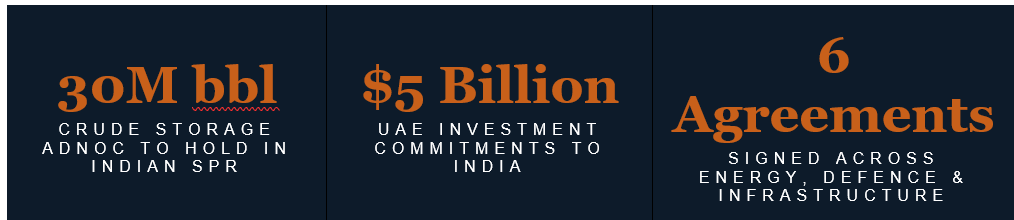
ADNOC to store 30 million barrels in Indian reserves; $5 billion investments pledged; LPG and defence pacts signed as West Asia tensions reshape energy diplomacy
Background: A Visit With Strategic Urgency
On 15 May 2026, Indian Prime Minister Narendra Modi made a brief but high-impact stopover in Abu Dhabi as the opening leg of a five-nation tour. The visit, though lasting approximately two and a half hours on the ground, produced outcomes that carry long-term structural significance for both nations. It came against a backdrop of acute regional turbulence: an ongoing Iran war has disrupted shipping through the Strait of Hormuz, through which approximately 60% of India’s crude oil imports pass, triggering urgent recalibration of India’s energy security architecture.
Modi was received at the Presidential Airport by UAE President Sheikh Mohamed bin Zayed Al Nahyan, who ordered a military jet escort for the Indian Premier’s arrival — a gesture both nations described as an honour reflecting the depth of the Comprehensive Strategic Partnership. In his opening remarks, Modi told the President: “I have come to my second home.” The UAE is home to approximately 4.5 million Indian nationals, the largest diaspora community in any single country.

Deal 1: ISPRL–ADNOC Strategic Petroleum Reserve Agreement
The centrepiece of the energy outcomes was a Strategic Collaboration Agreement between Indian Strategic Petroleum Reserves Limited (ISPRL) and Abu Dhabi National Oil Company (ADNOC). Under
this agreement, ADNOC is authorised to store up to 30 million barrels of crude oil in India’s Strategic Petroleum Reserve (SPR) facilities — a significant expansion of an arrangement that already made ADNOC the only foreign entity storing crude in India’s underground reserves.
India currently operates strategic petroleum reserve facilities at three locations: Visakhapatnam in Andhra Pradesh, and Mangaluru and Padur in Karnataka, with a combined storage capacity of approximately 5.33 million metric tonnes. The new agreement extends ADNOC’s participation to infrastructure at Visakhapatnam and includes development of a new reserve site at Chandikhol in Odisha. In a strategically significant reverse arrangement, the pact also opens the possibility of India storing crude oil in Fujairah, UAE — a deepwater port specifically positioned to bypass the Strait of Hormuz — which would materially enhance India’s emergency oil access during supply disruptions.
The agreement further provides the framework for collaborative development of LNG and LPG storage facilities on Indian soil, broadening the scope of the SPR relationship well beyond crude oil.
Deal 2: IOCL–ADNOC Long-Term LPG Supply Agreement
A separate Strategic Collaboration Agreement was concluded between Indian Oil Corporation Limited (IOCL) and ADNOC covering the long-term supply of Liquefied Petroleum Gas (LPG). The agreement creates a framework for ADNOC Gas Limited and IOCL to explore and finalise a long-term LPG sale and purchase arrangement. The UAE is already one of India’s leading suppliers of both crude oil and LNG, and this agreement is designed to formalise and extend LPG supply security over a multi-year horizon.
The LPG supply deal is particularly significant given India’s domestic demand growth for cooking gas and petrochemical feedstocks, and the vulnerability of Gulf supply routes to Strait of Hormuz disruptions. Securing a long-term agreement with a major Gulf producer provides India with contractual price and volume certainty in a market that has become structurally tighter.
Deal 3: UAE’s $5 Billion Investment Commitment to India
Alongside the energy pacts, UAE entities announced investment commitments totalling USD 5 billion into the Indian economy — cementing the financial dimension of the bilateral relationship. The composition of the investment package spans three major commitments:
- Emirates NBD Bank (ENDB): USD 3 billion invested in RBL Bank of India — the largest single component, deepening banking and financial sector integration between the two countries.
- Abu Dhabi Investment Authority (ADIA): USD 1 billion committed alongside the National Infrastructure & Investment Fund (NIIF) for priority infrastructure projects across India.
- International Holding Company (IHC): USD 1 billion invested in Sammaan Capital of India, covering capital markets and financial services.
India’s Foreign Secretary Vikram Misri noted that the UAE has been India’s cumulative seventh-largest investor over 25 years, and these new commitments represent a step-change in the pace and scale of UAE capital deployment into the Indian economy.
Deal 4: Strategic Defence Partnership Framework
India and the UAE also formalised a Framework for Strategic Defence Partnership — an agreement that elevates the bilateral security relationship to a structured, multi-domain footing. Areas of collaborationunder the framework include defence industrial cooperation, innovation and advanced technology, training and exercises, maritime security, cyber defence, secure communications, and interoperability between the two nations’ armed forces.
The timing of the defence pact is directly linked to the regional security context. The Iran war has fractured existing Gulf Cooperation Council alignments: the UAE has aligned openly with the United States and Israel, while other GCC members have taken divergent positions. India’s reaffirmation of support for free navigation through the Strait of Hormuz — a corridor vital to both nations’ energy and trade supply chains — was a central diplomatic signal of the visit.
UAE’s Fujairah Bypass Pipeline: A Supply Chain Hedge
Modi’s visit coincided with a strategically relevant infrastructure announcement from the UAE side: plans to double crude oil export capacity by constructing an additional pipeline to the Port of Fujairah by 2027. Fujairah’s significance lies in its geography — it is located on the Gulf of Oman, entirely outside the Strait of Hormuz, meaning crude loaded at Fujairah bypasses the most strategically vulnerable chokepoint in global oil supply. The pipeline expansion is an explicit hedge against Hormuz closure scenarios and directly complements the India-UAE strategic petroleum reserve arrangements.

Context: Why This Partnership Matters for the Oil & Gas Sector
India is the world’s third-largest oil importer, consuming approximately 5 million barrels per day. Roughly half of that volume transits the Strait of Hormuz under normal conditions — a dependency that has become a structural vulnerability since the Iran war began in late February 2026. Against this backdrop, the India-UAE deals represent a qualitative shift in how bilateral energy relationships are structured: moving from transactional commodity trade to sovereign-level infrastructure integration.
For the broader oil and gas trading community, the implications are significant. The ADNOC-ISPRL deal creates a new class of bilateral reserve-sharing arrangement that could serve as a template for other major consuming and producing nation pairs. The formalisation of long-term LPG supply agreements between IOCL and ADNOC signals that India is actively locking in supply certainty for sub-segments of its energy basket beyond crude oil. The $5 billion investment package, structured across banking, infrastructure, and capital markets, reflects the growing financial depth of Gulf sovereign wealth in Indian markets.
Bilateral trade between India and the UAE has already crossed USD 100 billion following the signing of their Comprehensive Economic Partnership Agreement (CEPA), with both governments targeting USD 200 billion in the coming years. The May 2026 agreements add energy security infrastructure and defence cooperation as new structural pillars beneath that trade relationship.
Tetranex Energies: Perspective for Oil & Gas Traders
For market participants and trading firms operating in the Gulf-India corridor, the implications of this diplomatic and commercial development are direct. The expansion of strategic petroleum reserves — and the formalisation of UAE crude storage in Indian facilities — reduces the risk premium associated with Hormuz-linked supply disruptions for cargoes sourced from ADNOC. Long-term LPG supply agreements between ADNOC Gas and IOCL will likely establish new reference price benchmarks for Gulf-India LPG trade. The Fujairah pipeline expansion, once operational in 2027, will materially change freight routing economics for ADNOC crude reaching Asian buyers.
Tetranex Energies will continue monitoring developments in the India-UAE energy corridor as the agreements progress from framework signatures to operational implementation. Traders and counterparties interested in positioning around Gulf-India energy flows are encouraged to engage with our research desk for detailed market analysis.
REFERENCES & SOURCES
[1] Business Standard. “India, UAE sign six agreements on LPG and strategic oil reserves.” 16 May 2026. https://www.business-standard.com/economy/news/uae-to-invest-5-bn-in-india-as-two-nations-deepen-energy-defence-ties-126051501219_1.html
[2] India TV News. “India-UAE ties deepen as PM Modi seals strategic defence, oil reserve deals and $5 billion boost.” 15 May 2026. https://www.indiatvnews.com/news/world/india-uae-ties-deepen-as-pm-modi-seals-strategic-defence-oil-reserve-deals-and-5-billion-boost-2026-05-15-1041248
[3] Open The Magazine. “UAE to Store 30 Million Barrels in India’s Oil Reserves: What PM Modi’s Visit Achieved.” 16 May 2026. https://openthemagazine.com/world/uae-to-store-30-million-barrels-in-indias-oil-reserves-what-pm-modis-visit-achieved
[4] The Tribune India. “India, UAE seal major oil reserve & LPG agreements as Modi backs Abu Dhabi amid West Asia tensions.” 15 May 2026. https://www.tribuneindia.com/news/india/india-uae-seal-major-oil-reserve-lpg-agreements-as-modi-backs-abu-dhabi-amid-west-asia-tensions/
[5] Manorama Yearbook / Current Affairs. “India, UAE sign energy, defence pacts | Strategic Petroleum Reserves.” 16 May 2026. https://www.manoramayearbook.in/current-affairs/india/2026/05/16/india-uae-agreements.html
[6] Malay Mail / Reuters. “India’s Modi begins five-nation UAE-Europe tour with focus on energy security and supply chains.” 15 May 2026. https://www.malaymail.com/amp/news/world/2026/05/15/indias-modi-begins-fivenation-uaeeurope-tour-with-focus-on-energy-security-and-supply-chains/220078
[7] Al Arabiya English. “India deepens defense, energy ties with UAE during PM Modi visit.” 15 May 2026. https://english.alarabiya.net/amp/News/gulf/2026/05/15/india-deepens-defense-energy-ties-with-uae-during-pm-modi-visit
[8] Organiser. “PM Modi clinches strategic oil and LPG deals in UAE.” 16 May 2026. https://organiser.org/2026/05/16/353685/bharat/five-nation-visit-pm-modi-secures-critical-crude-and-lpg-deals-in-high-stakes-uae-stop/
[9] Discovery Alert. “PM Modi’s 2026 UAE Visit: India’s Strategic Energy Partnership Deepens.” 15 May 2026. https://discoveryalert.com.au/pm-modi-uae-visit-india-uae-energy-partnership-2026/
[10] The Researchers. “UAE’s ADNOC to Store 30 Million Barrels of Crude Oil in India.” 16 May 2026. https://www.theresearchers.us/2026/05/16/uae-store-30-million-barrels-oil-india/
Hi, this is a comment.
To get started with moderating, editing, and deleting comments, please visit the Comments screen in the dashboard.
Commenter avatars come from Gravatar.